3D PRINTING & CAD service

WHAT IS ADDITIVE PRODUCTION?

Components are created layer by layer — directly from the CAD file

Additive manufacturing refers to all processes in which a component is constructed layer by layer from a digital geometry – in contrast to subtractive manufacturing, in which material is removed. It has been internationally defined since 2015 by ISO/ASTM 52900.
The methodological value lies not in the print itself, but in the freedom of geometry that it opens up: indentations, internal channels, periodic grids, function-graded structures – everything that classic practises exclude – becomes accessible. Additive manufacturing thus becomes the natural partner of bionic design.
This results in a separate design discipline: Design for Additive Manufacturing (DfAM). It differs from classic CAD as fundamentally as timber construction from steel construction — same tool, different logic.

“Additive manufacturing is not the faster injection moulding. It’s a different way of thinking about components.”

AT A GLANCE

Definition

ISO/ASTM 52900

since 2015 · Uniform terminology

FIRST PROCEDURE

SLA · 1986

Chuck Hull, US 4575330 A

PROCEDURALE CLASSES

7 nach ISO 52900 

FDM, SLA, SLS, MJF, SLM, BJT, …

KEY DISCIPLINE

DfAM

Design for Additive Manufacturing

BASIC PRINCIPLES

Four guiding principles for additive thinking.

DfAM is more than “printable construction”. These four principles are the grammar in which additive geometry works.

01

Geometry is free

Complexity costs nothing additively. Backcuts, internal channels and grids are accessible, where classic practises are excluded.

02

Function integrated

Several assemblies, common function, one print. Assembly steps disappear — tolerances with them.

03

Material differentiated

In the component, stiffness, density and porosity can vary depending on the location. Function gradient instead of material change.

04

Digital Thread

From the CAD model to the finished part without tools. Geometry is code — variants are a file, not a project.

HOW DOES THE METHOD WORK?

The process classes according to ISO/ASTM 52900

The standard divides additive manufacturing into seven process classes — each with its own physical principle, its own materials and its own field of application.

vpp

Vat Photo

SLA · DLP — Liquid resin is hardened by light. Highest detail fidelity.

mex

Material Extrusion

FDM — Thermoplastic strand is removed. Robust, favourable, versatile.

pbf

Powder Bed Fusion

SLS · MJF · SLM — Powder is selectively melted. Functional parts, metal.

mjt

Material Jetting

Drop-by-drop construction of photopolymers. Multiple materials at the same time.

bjt

Binder Jetting

Powder is glued locally by binder. Scalable, cost-effective on a large scale.

EXAMPLES FROM PRACTICE

Where additive manufacturing makes biomimicry possible.

Three applications in which the bionic solution would simply not be possible without 3D printing – and which would not justify 3D printing without biomimicry.

3D-Druck und CAD-Service bionisch inspirierte additive Fertigung
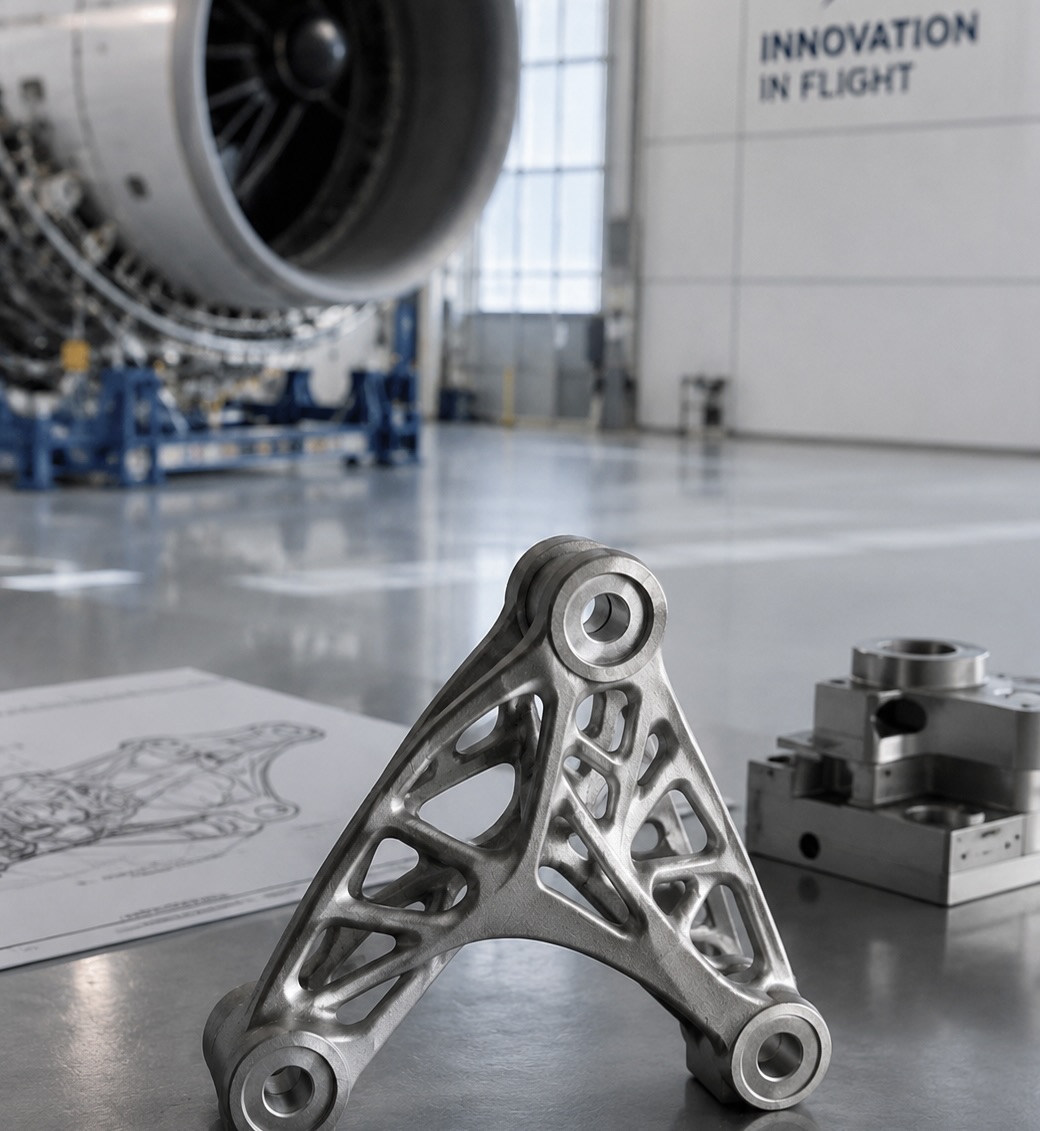
Aviation

Bionically optimised structure holder

Replace classic milling parts with topology-optimised printing parts — up to 45% easier at the same load. Geometry can only be produced additively.
Procedure · SLM (Metal) · since ~2014

3D-Druck und CAD-Service bionisch inspirierte additive Fertigung
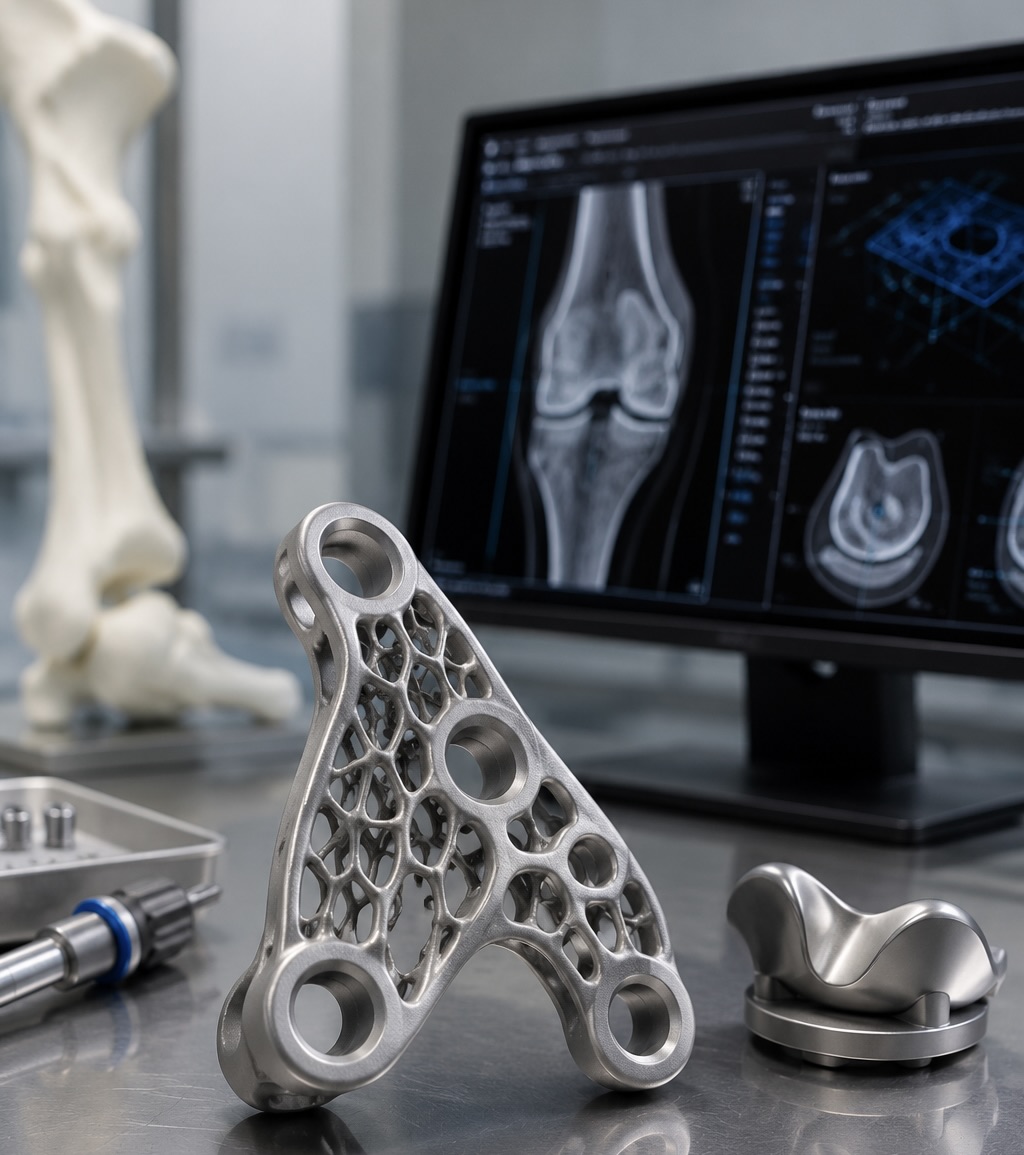
MEDICAL TECHNOLOGY

Patient-specific implants

Bone geometries based on CT data with internal trabecle structure — biocompatible, osseointegrative and patient-specific without tool costs.
Procedure · SLM · SLS · Clinical standard

3D-Druck und CAD-Service bionisch inspirierte additive Fertigung
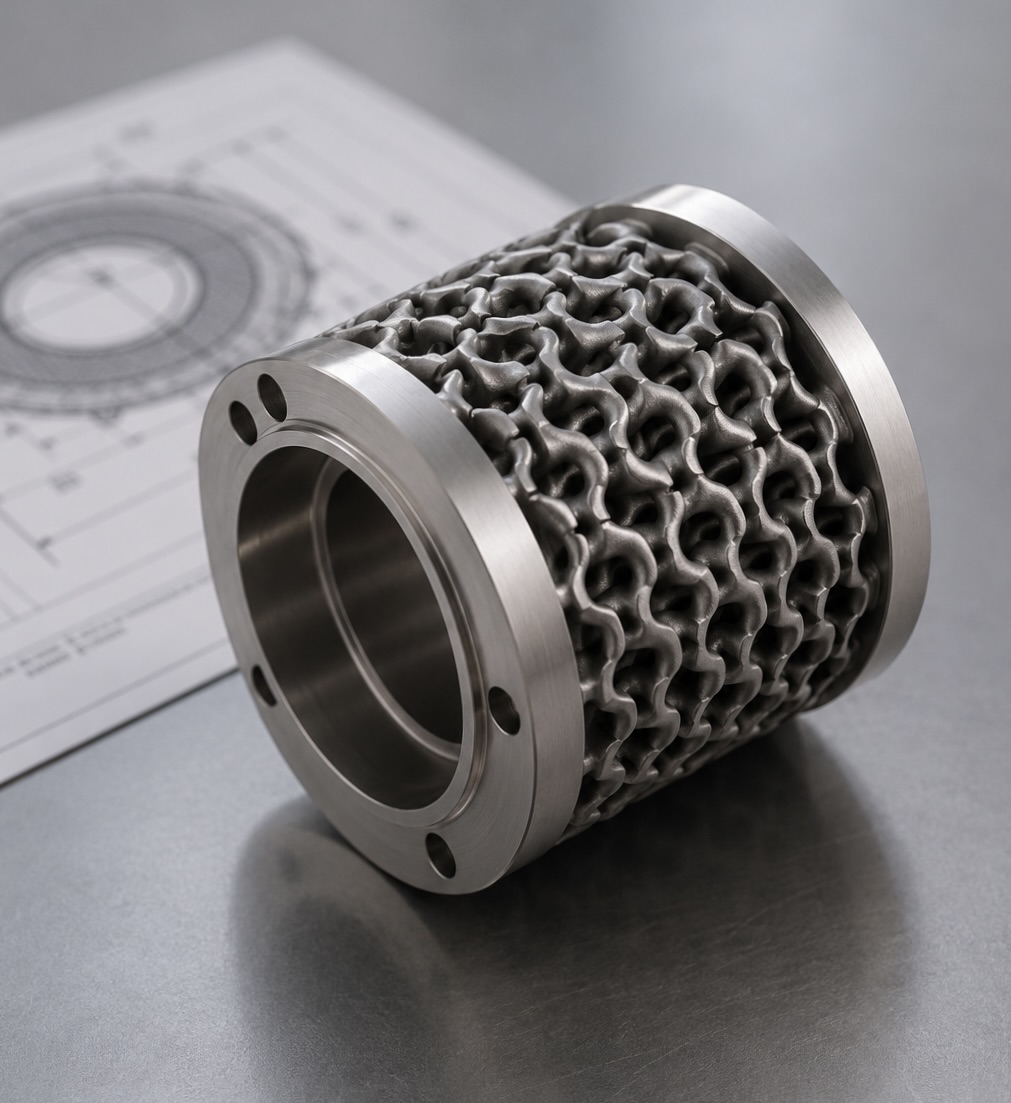
ENERGY TECHNOLOGY

Gyroid heat exchanger

TPMS grid structure with maximum heat transfer area at minimum volume — a geometry that classic manufacturing cannot produce.

Procedure · SLM · BJT · since ~2018

COMMISSION DIRECTLY

Calculate 3D print order online

Upload your CAD file and get an initial price estimate quickly. Free of charge and without obligation. Our team in the Rhine-Main region near Frankfurt will contact you promptly.

STANDARDS & FURTHER SOURCES

On what basis we work.

NORM

ISO/ASTM 52900 (2015 / 2021)

Additive Manufacturing — Fundamentals, Terminology and Classification.

RICHTLINIE

VDI 3405 (Several leaves)

Additive Manufacturing Processes — Process Descriptions and Quality.

PATENT

US 4575330 A (1986)

Chuck Hull — “Apparatus for production of three-dimensional objects” (SLA).

NORM

ISO/ASTM 52910 / 52911

Design guidelines — DfAM for polymers and metals.

BOOk

Gibson, Rosen, Stucker: Additive Manufacturing Technologies

Springer, 3. Edition. Standard work on practises and applications.

Research

Maskery et al. (2018)

Mechanical properties of printed TPMS grid structures, Acta Materialia.

Contact

Ready for your next project?

We look forward to your inquiry, whether concrete project, open question or first idea.