Materials & Surfaces

WHAT ARE FUNCTIONAL SURFACES?

Function arises at the boundary of two phases.

A functional surface is a boundary layer whose properties are specifically adjusted in order to create a technical effect, repel water, reduce friction, regulate heat, inhibit bacteria.

The decisive realisation of the last 30 years: geometry has a stronger effect than chemistry. Structures in the micro- and nanometer range already fundamentally change wetting behaviour, optical properties and adhesion without the material itself having to be replaced.

Materials science and surface technology work on three scales: macroscopic (form), microscopic (topography) and nanoscopic (molecule arrangement). Each scale addresses different physical phenomena.

“What happens on a surface decides whether a material works, not what it is.”

AT A GLANCE

Discipline

Surface Physics & Materials Science

SCALES

cm → nm

Six orders of magnitude relevant

KEY MODELS

Wenzel · Cassie-Baxter

wetting, 1936/1944

PHENOMENA

Hydrophobia · Tribology · Adhesion · Structure colour

MEASURING VARIABLES

Contact angle · Ra · COF

Standard parameters of functional surfaces

BASIC PRINCIPLES

Four laws that characterise any functional surface.

Those who develop surfaces work with physical rules, not with coating formulations. These four principles are the workbench.

01

Geometry beats chemistry

A pure polymer surface becomes superhydrophobic by structuring, without fluorine-containing additives. Mould acts before fabric.

02

Scale determines effect

Friction, wetting and colour are created on its own scale. Those who micro-structure do not necessarily influence the visual impression.

03

Function is measurable

Contact angle, coefficient of friction, adhesion force, each function has an established measuring variable. “Effects” does not apply.

04

Hierarchies have a stronger effect

Natural models combine several scales at the same time. A single structural layer rarely achieves the same robustness.

HOW DOES THE METHOD WORK?

Scales of a functional surface.

Materials science does not address “the surface”, but a hierarchy of interlocking scales. Each scale has its own effects and production processes.

cm

Macro form

Component geometry · Flow routeing · Curvatures

mm

Riblets & Textures

Flow grooves · gripping structures · tactile fields

µm

Micro-topography

Pillars · Pits · Gradients · Wetting Control

nm

Nano-structures

Anti-reflection · Photonic crystals · Structure colour

Å

Molecular layer

SAMs · Coating chemistry · Functionalisation

EXAMPLES FROM NATURE

Where structures work, where substance alone fails.

Three surfaces that show well why materials science has become geometry science today.

Funktionale Oberflächen und Materialien nach bionischen Prinzipien
HYDROPHOBIA

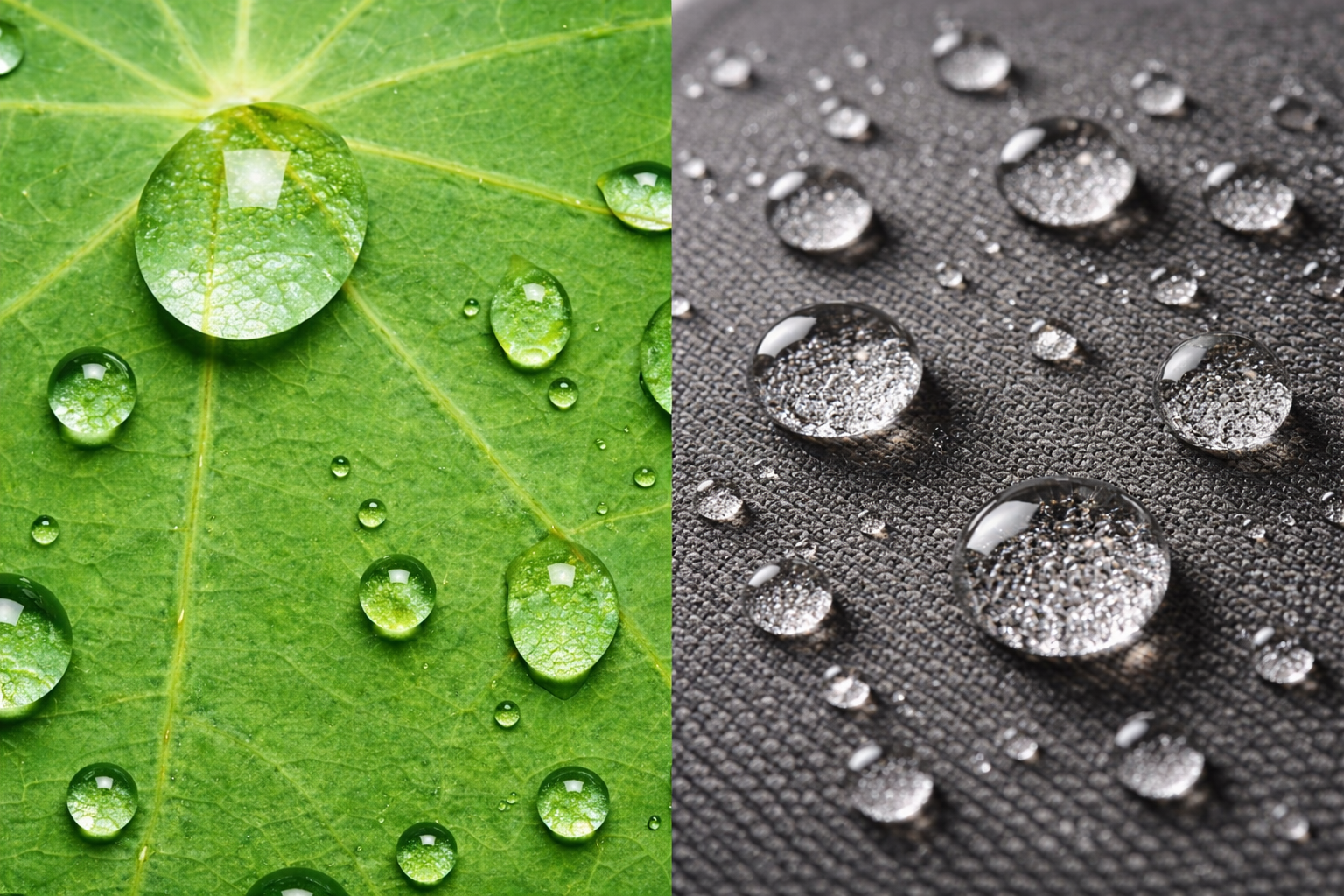
Lotus effect

Micropapilles plus nanowax create a contact angle > 150°. Water beads off and takes particles with it. Chemically, the leaf is not particularly water-repellent.

Effect · Superhydrophobia · Scale · µm + nm

Funktionale Oberflächen und Materialien nach bionischen Prinzipien
TEXTURE COLOUR

Morpho-Both

The bright blue is created without pigment, by interference on stacked nanolamelles. The same colour without dye, without fading.
Effect · Interference · Scale · nm

Funktionale Oberflächen und Materialien nach bionischen Prinzipien
FRACTURITY

Mother-of-pearl

95% brittle lime, 5% proteins and 3000 times fracture resistance compared to the pure material. A wall geometry that deflects any crack reproduction.

Effect · Hierarchical network · Scale · µm + nm

STANDARDS & FURTHER SOURCES

On what basis we work.

NORM

DIN EN ISO 4287 / 4288

Geometric product specification — surface texture, tactile cutting.

MODEL

Wenzel (1936) · Cassie-Baxter (1944)

Classic models for describing the wetting of textured surfaces.

Research

Barthlott & Neinhuis (1997)

First publication of the lotus effect, Planta 202.

NORM

DIN EN ISO 25178

Surface characterisation — 3D topography of functional surfaces.

Book

Bhushan, B.: Biomimetics — Bioinspired Surfaces

Springer, 2016. Reference work on the microstructure of functional surfaces.

Association

DGM — German Society of Materials Science

Specialist committees on surface technology and functional materials.

Contact

Ready for your next project?

We look forward to your inquiry — whether concrete project, open question or first idea.