Biomimicry according to DIN EN ISO 18458

WHAT IS BIOmimicry?

Learning from the best research laboratory in the world: nature.

Biomimetics is a scientific discipline that analyses, abstracts and transfers structures, processes, and functional principles of biological systems. It’s not inspiration, it’s method.

The focus is not on the form of the model, but its functional principle: the active cause behind an observed performance. Biomimicry separates one from the other, systematically, documented and reproducible.

Since 2015, the international standard DIN EN ISO 18458 regulates this transmission process. It defines terms, methods and requirements and makes “biomimicry” a verifiable claim. For Scho & Müller, this standard is not only a reference, but a lived working basis. Each project follows the same methodical path: from the biological phenomenon to the abstraction to the technical solution.

„Biomimicry is not a game of engineering, but its oldest and at the same time most modern extension.”

AT A GLANCE

Term

Biomimicry

Artificial word from biology + imitation

Norm

DIN EN ISO 18458

Since 2015 · Concepts, Terms & Methods

Procedure

Top-down · Bottom-up

Two main directions of transmission

BASIC PRINCIPLES

Four guiding principles that distinguish biomimicry.

Not everything that looks like nature is biomimicry. These four principles are the methodological basis — and at the same time the dividing line to the pure natural metaphor.

01

Function over form

The principle of action is transmitted, not the appearance. A biomimetic solution must be allowed to look biologically unsimilar.

02

Abstraction is mandatory

There is always a step of generalisation between role model and technology. Without abstraction, copy remains.

03

Reproducible document

Each transmission follows a comprehensible path. ISO 18458 requires explicit document chains — from the phenomenon to the component.

04

Interdisciplinary constructed

Biologists and engineers work on an equal footing. A discipline alone produces either beautiful images or weak models.

HOW DOES THE METHOD WORK?

The biomimetic transmission Process

According to ISO 18458, biomimicry runs neither linear nor free — but as a guided iteration between biological model and technical application.

01

Observe

Identify biological phenomenon — through fieldwork, literature or research databases such as AskNature.

02

Analyse

What physical, chemical or geometric mechanisms contribute to the performance of the organism?

03

Abstract

Release the principle of action from the biological carrier. What remains if you take away the living?

04

Transfer

Embedding principle in the technical application — adapted to materials, scale and production.

05

Verify

In the experiment, prove that the performance is actually achieved in the technical context.

EXAMPLES FROM NATURE

Classics that show how bionics works.

Three translations that today explain the term bionics to every engineering degree program – and which all follow the same method pattern.

Bionik nach DIN EN ISO 18458 biologische Prinzipien für technische Anwendungen
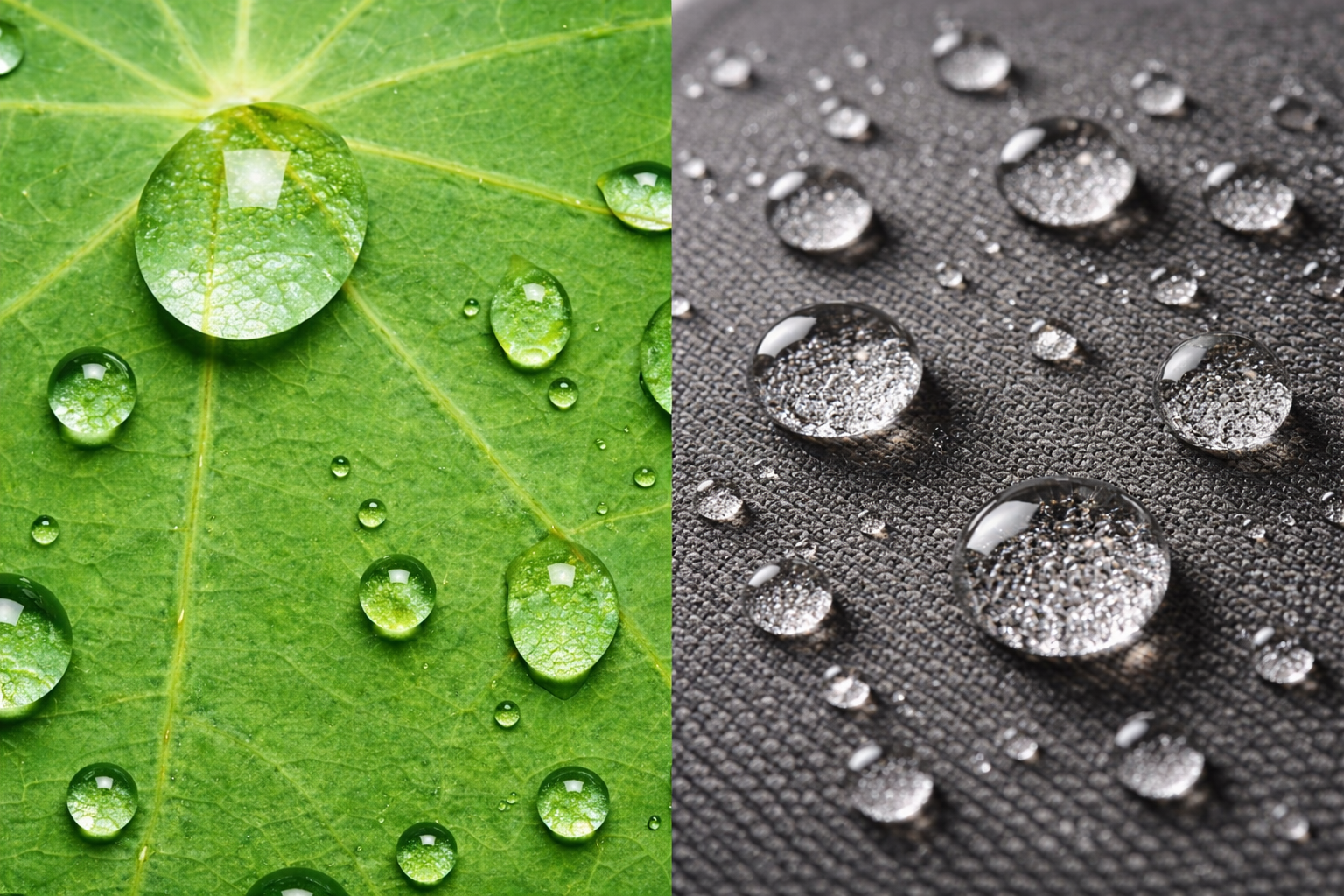
LOTUS EFFECT

Lotus: Self-cleaning facades

The double structure of micropapillaes and wax crystals allows water to bed and dirt to carry away. Transferred to facade colours, solar panels and medical surfaces.
Example · Nelumbo nucifera · since ~1990

Bionik nach DIN EN ISO 18458 biologische Prinzipien für technische Anwendungen
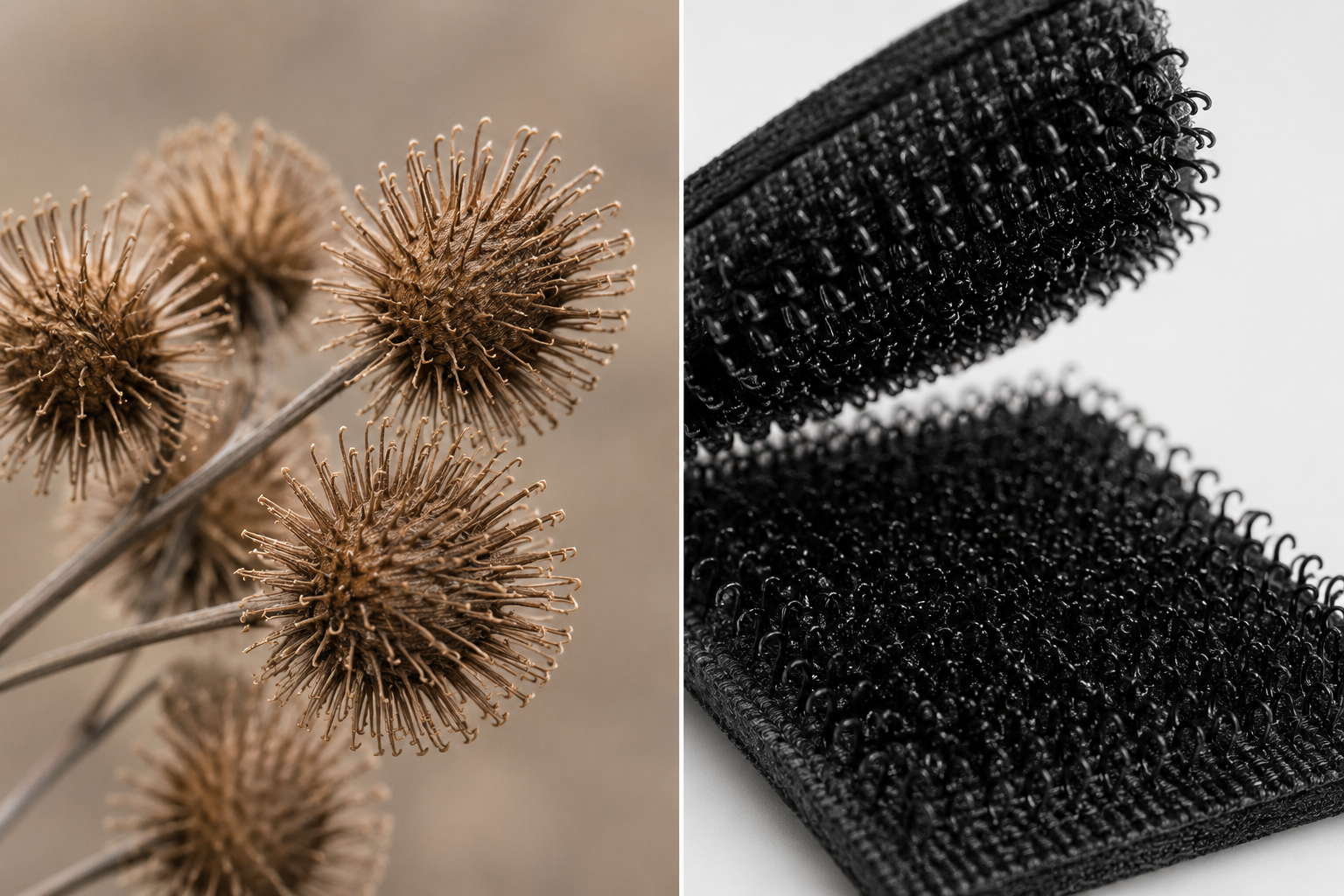
Velcro fastening

Burdock: Resealable Connection

From dog fur observation 1941: Micro hooks of the plant hang in loops. The principle has been transferred unchanged and is one of the most successful bionics products ever.
Example · Arctium lappa · since 1955

Bionik nach DIN EN ISO 18458 biologische Prinzipien für technische Anwendungen
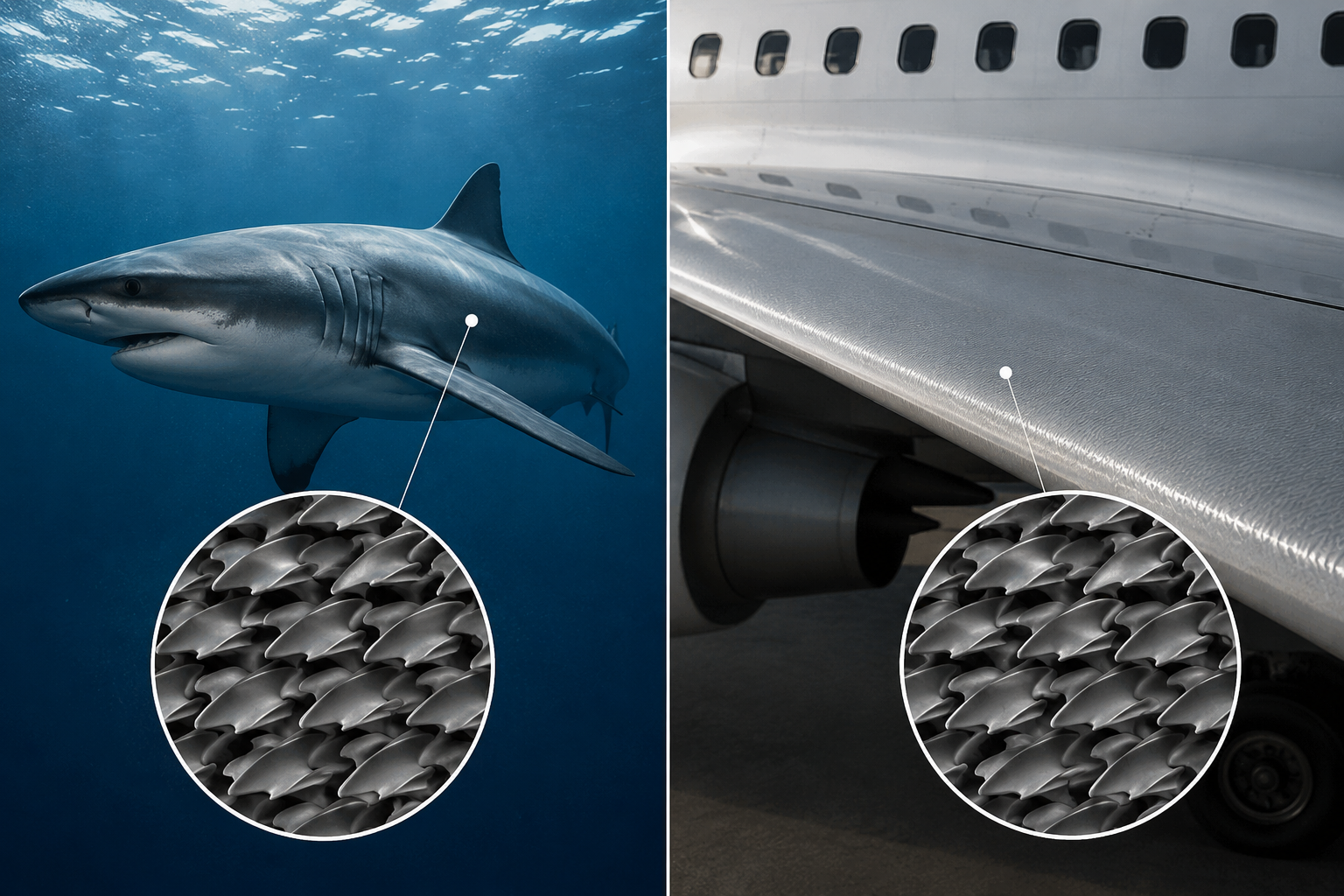
RIBLET STRUCTURES

Shark: Fluid-optimised skin

Microscopic longitudinal groots reduce the frictional resistance of turbulent flow by up to 10%. Today in swimsuits, airplane wings and rotor blades.

Example · Carcharhinus · since ~1985

STANDARDS & FURTHER SOURCES

On what basis we work.

NORM

DIN EN ISO 18458 (2015)

Bionics — concepts and methods. Beuth Publishing.

Guideline

VDI 6220 Blatt 1 (2012)

Biomimicry — Conceptualisation and Strategy.

Data bank

AskNature.org · Biomimicry Institute

Function-oriented search for biological role models.

NORM

DIN EN ISO 18459 (2015)

Structure optimisation by biomimicry— procedures and terms.

Book

Nachtigall, W.: Bionik — Basics and examples

Springer, 2002. Standard work of German biomimicry.

Association

BIOKON e.V.

Competence Network Biomimetics — Research & Industry.

Contact

Ready for your next project?

We look forward to your inquiry — whether concrete project, open question or first idea.